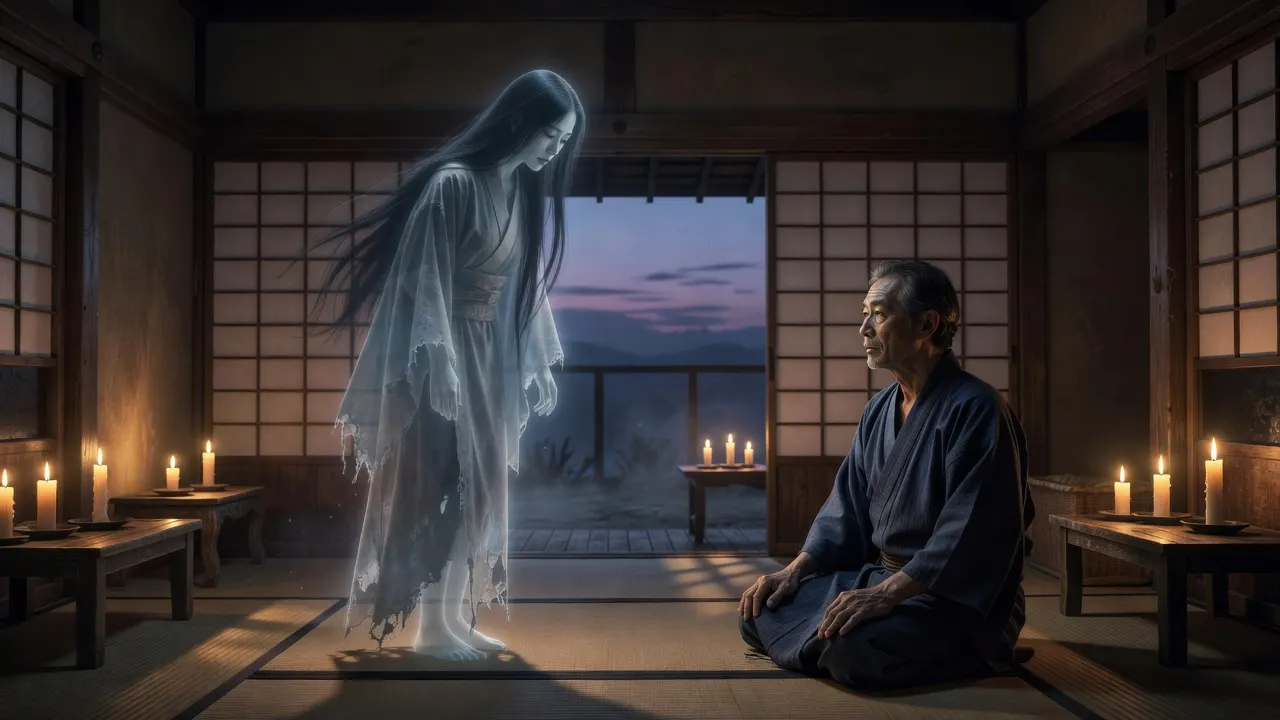
Yūrei are ghosts of the dead who remain bound to the human world, often through unsettled feelings or attachments. Their stories connect supernatural fear with ordinary questions of grief, remembrance and unfinished relationships. Rather than treating them only as monsters, these tales invite readers to consider what a spirit’s lingering presence might express about the living.
Key facts
- Yūrei are spirits of dead people who have not moved on. [F28]
- Shinto belief holds that souls may become restless if the dead are not properly honoured. [F14]
- Traditional stories can suggest that resolving a ghost’s grievance may allow it to rest. [F33]
Yūrei stories give unfinished feelings a ghostly form
At the centre of the yūrei is not simply a frightening death. The defining feature is what the spirit could not leave behind. That might be understood as attachment, grief or an unresolved relationship. The image makes emotional bonds visible through a supernatural figure. [F21, F23]
This gives the ghost a human connection, even when its presence frightens. Yūrei are described as spirits unable to complete their movement away from the human world. Their stories therefore make separation itself part of the mystery: death has occurred, but the relationship is not presented as finished. [F19, F22]
That connection does not require a reader to believe in ghosts. Yūrei continue to appear in cultural settings where literal belief has little social force. One interpretation is that they reveal the difficulty of bringing certain relationships to an end, rather than proving anything about an afterlife. [F17, F18]
Folklore also links the spirits to wider beliefs about death and the afterlife. The yūrei tradition has been shaped by Buddhism, including its ideas of karma and reincarnation. Shinto beliefs about spirits in the natural world also form part of accounts of their origins. [F2, F6; F11]
Ritual and art shape how the ghosts are remembered
In Shinto, the dead may become restless when they are not properly honoured. This belief connects yūrei stories with acts of remembrance, not only with fear. The ghost becomes a figure through which folklore can express obligations between the living and the dead. [F14]
That link between memory and the supernatural appears in descriptions of ancestral customs. One account presents the yūrei as a dark reflection of a culture that honours ancestors and welcomes the dead. The same account says white is associated with death and mourning in Japan, and describes the ghost wearing burial clothes. [F31, F32]
Artists have also helped make the spirits recognisable. Traditional Japanese woodblock prints show yūrei surrounded by mist or floating in a dreamlike state. Another account describes yūrei paintings on hanging scrolls, sometimes displayed during the ghost season around Obon. [F16; F27]
The ghost’s cultural meaning is not identical to that of every supernatural being. Yūrei are distinguished from yōkai and kami, while another explanation notes that most yōkai are not the ghosts of people. Keeping those categories separate helps readers see why yūrei stories focus so closely on human lives and bonds. [F7; F26]
Modern horror carries old tensions into new settings
Yūrei have not stayed within traditional tales or pictures. The figure has returned in contemporary horror, where it can bring old fears into settings familiar to modern audiences. This continuing presence reflects a broader fascination with the ties between life and death. [F29; F10]
Modern adaptations can change the setting without discarding the older tradition. One account describes the novel Ring and its film adaptation as placing yūrei mythology in a technological landscape while retaining its folkloric roots. It also describes Ju-On as removing clear causality, creating a more unsettling kind of horror. [F34, F35]
The emotional connection remains important in interpretations of these ghosts. One commentary argues that yūrei can give voice and power to silenced suffering. It also observes that iconic yūrei are often women harmed by men or by systems that failed them. These are interpretations of the tradition, not a rule that every ghost story follows. [F37, F38]
Traditional stories may offer a different kind of ending: resolve the ghost’s grievance, and it may rest. Yet another account characterises the tradition as often pessimistic. The contrast helps explain why some stories suggest repair, while others leave the haunting unresolved. [F33, F40]
What this means for you?
Yūrei stories can be approached as folklore, horror or a way to think about remembrance. You do not need to choose one reading. A ghost may work as a supernatural character within a tale and, at the same time, as a symbol of an attachment that remains difficult to set down. [F20, F23]
If you are a reader drawn to the frightening image, notice what the story says the spirit could not leave behind. That question can shift attention from appearance to motive. It also helps distinguish a yūrei story from a tale about a supernatural being that is not the ghost of a human. [F21; F26, F28]
You can also ask how remembrance shapes the plot. Does the story connect restlessness with a failure to honour the dead? Does it imagine that a grievance can be resolved? These questions stay close to the themes found in the folklore without treating a ghost story as evidence that a real haunting has occurred. [F14; F33]
For a film or artwork, look at how the image guides your response. Mist, a floating figure or burial clothing can make a spirit seem distant and uncanny. The cultural meanings attached to those images matter, so avoid assuming that a familiar horror image has the same meaning in every tradition. [F16; F32]
Finally, keep interpretation open. Yūrei appear in cultural life even where literal belief carries little force, and their meaning can centre on relationships rather than the afterlife. Treating that possibility with care makes room for both the story’s supernatural atmosphere and its human concerns. [F17, F18]
What to do now?
- Choose a yūrei story, image or film, and write down what the spirit seems unable to leave behind. This focuses your reading on the attachment rather than only on the frightening appearance. [F21, F23]
- Notice whether the story connects restlessness with remembrance or honouring the dead. Keep that observation separate from any claim about what happens after death. [F14]
- Compare the ghost with other supernatural figures, and check whether it is specifically a dead human spirit. This prevents different folklore categories from being treated as interchangeable. [F26, F28]
- Look closely at the image-making: note mist, floating forms or burial clothing where they appear. Ask how those details shape the mood, rather than assuming they explain the whole tradition. [F16; F32]
- When a story offers a resolution, consider what grievance is addressed and whether the spirit is allowed to rest. If no resolution comes, consider how that changes the story’s emotional effect. [F33, F40]
Sources
- japaneserituals.com/yurei
- japanese.mythologyworldwide.com/the-tale-of-the-yurei-ghostly-legends-of-japan
- kuhkisatsujin.net/yurei-evolution-japanese-ghost-mythology-to-modern-horror
- japanese.mythologyworldwide.com/the-mysterious-yurei-japanese-ghosts-and-their-stories
About this page
Written with AI assistance from the sources listed above, then checked by automated fact, source, repetition and quality checks before publishing.
Facts and links checked on 3 November 2026. Summarises the sources linked above; check the linked source for the latest version.
How we researched this: we compiled this guide from the official and independent sources listed above, and checked the facts on the date shown. Our editorial policy explains how we choose and check sources.